


Views: 1 创始人: Site Editor Publish Time: 2026-03-27 Origin: Site


When the silicon carbide power chip continues to operate at a high
temperature of 175°C in the motor controller of a new energy vehicle, the
connection layer inside the silicon chip is being tested – the traditional
tin-based solder is close to the softening point at this temperature, while the
connection layer sintered by nanocubic silver particles remains unmoving,
ensuring stable current and heat transmission with a shear strength of 31MPa
and an ultra-low porosity of 0.76%. This cubic silver particle with a side
length of only 54nm is subverting the technical paradigm in the field of
electronic packaging with its unique microstructure, turning high-reliability
connectivity under low temperature and low pressure conditions from a
laboratory idea to an industrial reality.
1. The dilemma and breakthrough direction
of packaging technology
Electronic packaging technology always
seeks a balance in the triangle of
"performance-temperature-pressure". As the power density of
third-generation semiconductor devices exceeds 300W/cm², the limitations of
traditional packaging solutions are becoming increasingly prominent: the
melting point of tin-lead solder (183°C) is difficult to cope with the
long-term high-temperature operation of SiC chips; Spherical silver nano solderpaste can achieve sintering below 250°C, but requires an applied pressure of 1-10MPa,
resulting in a breakage rate of up to 3% on thin chips (<100μm). This
contradiction is particularly prominent in the field of new energy vehicles - a
reliability test of a car company shows that IGBT modules using high-pressure
sintering process have a failure rate of 45% of the total due to chip
microcracks after 1,000 temperature cycles.
The industry has tried a variety of
technical paths to break through this dilemma. By optimizing the particle size
distribution of spherical silver particles (30-50nm), the Japanese scholar IDE
reduced the sintering pressure to 5MPa, but the shear strength was reduced to
25MPa. The American MEI team introduced current-assisted sintering technology,
which achieved a pressure-free process, but the silver layer oxidation problem
caused by local overheating increased the joint resistance by 20%. It was not until
the discovery of the nanocubic silver structure that a new idea was provided to
solve this contradiction - its 23% surface atom ratio (only 8% of spherical
particles) created a huge surface energy, and with the self-assembled
superlattice structure, the atomic diffusion rate reached 2.5 times that of
spherical particles at 280°C, fundamentally reducing the dependence on external
pressure.
2. Microstructure and performance mechanism
of nano-cubic silver
Under transmission electron microscopy, the
nanocubic silver particles exhibit a near-perfect crystal structure – (100) the
crystal surface is clearly visible, and the side length deviation is controlled
within ±5nm. This precise geometry gives it three key properties that together
form the core advantages of low-temperature and low-pressure sintering. Surface
energy-driven self-assembly behavior is the most notable feature. When the
nanocubic silver particles are dispersed in the organic support, the van der
Waals force between their {100} crystal planes is directional, and the
face-centered cubic stacking structure is spontaneously formed under the action
of ultrasonic vibration (300W, 40kHz), and the average spacing between the
particles is only 2-3nm. This ordered arrangement increases the neck growth
rate during sintering by 40%, and a comparative experiment showed that the neck
diameter of the cubic silver particles reached 60% of the initial particle size
in 30 minutes at the same temperature, compared to only 35% for the spherical
particles. What's more, this self-assembly eliminates the need for external
pressure coercion, eliminating the risk of chip damage at the source.
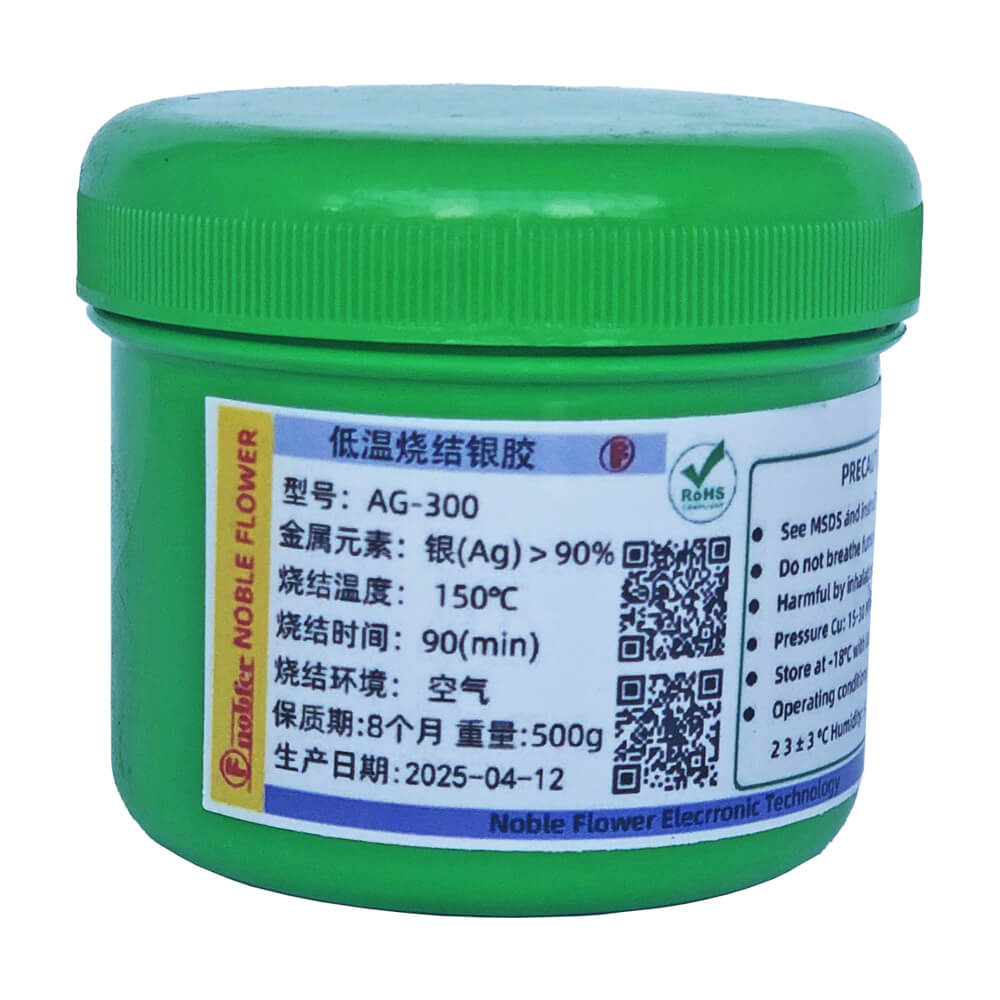
The optimization of the atomic diffusion path stems from its unique crystal orientation. The contact surface of the cubic silver particles is a {100} crystal surface with dense atomic arrangement, and the atomic diffusion activation energy is reduced by 30% compared with the random contact interface of spherical particles. High-resolution electron microscopy showed that at 150°C, there was a significant grain boundary diffusion between cubic silver particles, while the spherical particles did not observe a similar phenomenon until they reached 200°C. This low-temperature activity allows the sintering process to be completed within the temperature window (150-280°C) when the organic matter is fully decomposed, avoiding the effect of residual carbon on the conductivity - X-ray photoelectron spectroscopy shows that the carbon content of the final sintered layer is only 0.05%, which is much lower than the 0.3% of spherical silver paste. The intelligent regulation of PVP coating solves the stability problem of nanoparticles. The nano-cubic silver prepared by polyol reduction method is uniformly coated with a 3.3nm thick polyvinylpyrrolidone (PVP) molecular layer, and its pyrrolidone group forms a coordination bond with the silver surface, which can effectively prevent particle agglomeration for more than 6 months under storage conditions at 4°C. Thermogravimetric analysis (TGA) showed that when the temperature rose to 150°C, PVP began to decompose in stages - 150-200°C to remove adsorbed water and low molecular weight components, and 200-280°C to break the backbone into CO₂ and H₂O, with a final residue of < 0.5%, which not only ensures storage stability but also does not affect the conductive network after sintering.
3. Precise control of solder paste
preparation and process parameters
Translating the material potential of
nanocubic silver into practical properties requires crossing multiple process
challenges, from particle synthesis to sintering molding. Slight deviations in
each parameter can lead to huge differences in final performance. The
controllable preparation of nanocubic silver is the starting point of the
entire process chain. In ethylene glycol solution at 160°C, silver nitrate
reacts with PVP at a molar ratio of 1:0.8 for 3 hours, and the particle
morphology is regulated by precisely controlling the following parameters: the
reaction temperature fluctuates ≤±2°C to avoid particle deformation caused by
local overheating; The stirring rate is stable at 500rpm to ensure the uniform
concentration of the reaction system. PVP molecular weight selection of 10,000
to form an optimal coating thickness of 3-4nm.
Scanning electron microscopy analysis
showed that the cubic silver particles prepared by this process had a
structural integrity rate of more than 95%, an average side length of 54nm, and
a standard deviation of size distribution of <5nm, which provided
high-quality raw materials for subsequent solder paste preparation.
Solder paste formulation optimization is
like the art of formulation in the microscopic world. 83% (mass fraction) of
nano-cubic silver forms a homogeneous dispersion system with the organic
carrier, in which the composition of the organic carrier is determined by 20
orthogonal experiments: 60% ethylene glycol monoethyl ether is used as the
solvent, providing a printing viscosity of 100-150Pa·s; 20% ethylcellulose as an adhesive to ensure no sagging after
application;
15% Span - 80 as a surfactant, reducing the
contact angle from 35° to 15°; 5% citric acid is used as a combustion aid to
reduce the surface energy barrier of silver particles. Through gradient
grinding (roll distance 50μm→20μm→5μm) of the three-roller machine, the silver
particle aggregates are completely dispersed, and the final solder paste has a
particle size distribution of D90<5μm, meeting the requirements of fine
printing. Substrate pretreatment lays the foundation for high-quality
connections. The 3mm×3mm and 10mm×10mm copper block surfaces are sputtered to
form a 1μm thick silver coating, which achieves dual efficiency: the Ag-Ag
connection interface is constructed, which reduces the contact resistance of
the Ag-Cu interface by 60%;
The silver plating acts as a diffusion
barrier to control the migration of copper atoms at high temperatures to less
than 0.1%. After 10 minutes of ultrasonic alcohol cleaning of the silver-plated
surface, the water contact angle is reduced from the initial 65° to 15°,
significantly improving the wettability of the solder paste and creating good
conditions for subsequent sintering.
4. Temperature curve design and mechanism
analysis of sintering process
Thermogravimetric analysis (TGA) depicts a
clear thermal behavior trajectory for nanocubic silver solder paste, which
serves as a scientific basis for process design. At a ramp-up rate of 10°C/min,
the mass change of solder paste presents two characteristic stages
corresponding to different physicochemical processes.
The low-temperature stage (25-150°C)
focuses on organic matter removal. The cumulative weight loss at this stage was
16.6%, mainly due to solvent volatilization and binder decomposition, among
which the maximum weight loss rate (0.25%/°C) occurred in the range of
100-120°C, corresponding to the rapid volatilization of ethylene glycol
monoether. To avoid stomatal defects caused by violent reactions, a slow
heating rate of 5°C/min was used and kept warm at 150°C for 20 minutes, so that
more than 90% of the organic matter was smoothly removed at this stage.
Comparative experiments have shown that this insulation step reduces the final
porosity from 1.2% to 0.76%, as premature entry into the high-temperature zone
can lead to the carbonization of residual organic matter to form micropores.
The high temperature stage (150-280°C)
determines the densification of the sintered joint. After the temperature
exceeded 150°C, the weight loss rate dropped below 0.05%/°C, indicating that
the organic matter was largely removed, at which point the silver nanoparticles
began to diffuse through the surface to form a sintered neck. In order to
reduce the consumption of non-dense diffusion in the low temperature zone, a
rapid heating of 10°C/min is used to quickly reach the sintering point of
280°C. During the 30 minutes of insulation at 280°C, the atomic diffusion
mechanism changes - the first 10 minutes are dominated by surface diffusion,
and the initial connections are formed between the particles. 10-20 minutes
grain boundary diffusion dominated, and the sintering neck continued to
thicken; The lattice diffusion is dominant in the last 10 minutes, achieving
overall densification.
Ultrasound-assisted and low-voltage control
are key to process innovation. Substrates coated with solder paste (60μm thick)
were sonicated for 5 minutes to increase particle density by 20%, equivalent to
applying 1MPa pressure. During the sintering process, special fixtures provide
a slight pressure of <1MPa, which does not promote densification, but
ensures good contact between the solder paste and the substrate while
inhibiting the escape of bubbles caused by organic volatilization. This
low-voltage condition reduces the chip bending deformation from 5μm in
traditional processes to less than 0.5μm, fully meeting the packaging
requirements of MEMS devices.
5. Performance characterization and
reliability verification of sintered joints
The excellent performance of nano-cubic
silver sintered joints has been fully verified in macroscopic testing and
microanalysis, and its comprehensive indicators not only meet the stringent
requirements of power devices, but also show the potential to surpass
traditional technologies.
Mechanical properties tests show excellent
connection strength. The thrust-displacement curve tested with the HKE-3132
Push-Pull Tester (30mm/min) showed that the maximum thrust was 281N
(corresponding to the displacement of 2.60mm), and the calculated shear
strength was 31MPa, which far exceeded the minimum requirement for power device
packaging (15MPa). What's more, this strength remains stable over temperature
cycles ranging from -55°C to 200°C – after 1000 cycles, the strength retention
rate is still 90%, compared to only 65% for conventional spherical silver paste
under the same conditions. Fracture behavior analysis reveals characteristic
patterns of cohesive failure. Scanning electron microscopy showed that more
than 90% of the fracture surface showed typical ductile fracture
characteristics: there were tear lines consistent with the stress direction.
Distribute a large number of closed tough sockets with a diameter of 1-2 μm;
The thickness of the residual silver layer is uniform (3-5 μm).
This fracture pattern suggests that the
stress is mainly absorbed by the plastic deformation of the sintered silver
layer itself, rather than brittle separation at the interface, which is
completely consistent with the fracture theory of nanosilver sintered joints
proposed by Tan et al., confirming the high-quality bonding of the joints.
Microstructural characterization shows a
uniform and dense silver layer structure. Cross-sectional SEM images show a
reduction in sintered silver layer thickness from an initial 60μm to 40μm with
a shrinkage rate of 33%, mainly due to two processes: slight pressing of the
chip during insertion to extrude about 10μm of solder paste; Sintering
densification causes shrinkage by about 10μm. Energy dispersive spectrometry
(EDS) analysis confirmed that there was significant elemental cross-diffusion
at the interface between the silver layer and the copper substrate, with copper
atoms diffusing to the silver layer at a depth of 2μm, which is consistent with
the theory that the diffusion coefficient of Cu in Ag (10⁻¹⁴cm²/s) is much
higher than that of Ag in Cu (10⁻¹⁶cm²/s), which further enhances the
interfacial bonding strength.
Porosity control reaches the
industry-leading level. The longitudinal SEM images were binarized by MATLAB
software, and the porosity was calculated to be only 0.76%, and most of these
pores were isolated micropores with a diameter of < 500nm, which did not
form a connected defect path. In contrast, the sintering porosity of
traditional spherical silver particles at low pressure is usually more than 5%,
and there are a large number of connecting pores, which seriously affects the
thermal conductivity. This low porosity results in a thermal conductivity of
230W/(m·K) for nano-cubic silver sintered layers, which is 40% higher than that
of traditional low-pressure sintered products.
6. Industrial application and technology
evolution direction
The industrialization process of nano-cubic
silver solder paste is accelerating, and its unique advantages make it show the
potential to replace traditional packaging materials in many fields, while the
technology itself continues to be iteratively optimized.
In the field of new energy vehicles, the
motor controller test of a leading car company showed that the power density of
SiC modules encapsulated in nano-cubic silver solder paste increased by 30%,
and the continuous operating life at 175°C exceeded 100,000 hours, which was 2
times longer than the traditional solution. What's more, the low-voltage
process reduces the breakage rate of thin chips (50μm) from 3% to 0.1%,
increasing the annual revenue of a single line by more than 5 million yuan.
Power amplifiers for 5G base stations also
benefit from this technology. When GaN devices are sintered with nanocubic
silver, the thermal resistance is reduced from 0.2K·cm²/W to 0.07K·cm²/W, reducing the
operating temperature by 15°C and improving signal stability by 20%. Field
tests by an operator showed that base stations using this technology had a 60%
reduction in call drop rates in high summer environments.
The path of technology upgrade is clearly
visible:
Cost optimization: Developed silver-clad
copper cubic particles (silver layer thickness 5nm) to reduce material costs by
50% while maintaining 80% performance;
Process expansion: Reduce the sintering
temperature below 200°C to meet the packaging needs of flexible substrates
(such as PI films).
Performance improvement: Through the
particle size gradient design (20nm+50nm+100nm), the porosity is further
controlled below 0.5%.
These innovations will drive the
penetration of nanocubic silver solder paste from the high-end field to the
mass market such as consumer electronics, and its market size is expected to
exceed 1 billion yuan by 2026, accounting for more than 35% of low-temperature
sintered materials.
Conclusion: The macroscopic value of
microstructure
The success of nano-cubic silver solderpaste is essentially a technical dividend released by the precise regulation of
the microstructure of the material. When the 54nm silver cube forms a
superlattice structure through self-assembly, it not only achieves
high-strength connection under low pressure conditions, but also reshapes the
technical logic of electronic packaging - from "forced connection"
relying on external pressure to "intelligent bonding" using the
material's own properties.
This shift goes far beyond the technology
itself. In the context of the "double carbon" goal, its
low-temperature process can reduce the energy consumption of the packaging
process by 40%; In the process of independent and controllable semiconductor
industry, it provides a new path for breaking through the dependence on
high-end solder paste imports; In the development of smart manufacturing, its
digital process parameters (temperature ±2°C, pressure ±0.1MPa) set new
standards for precise control of the packaging process.
As third-generation semiconductor
technology continues to evolve, the requirements for packaging materials will
become more stringent, but the innovative ideas demonstrated by nanocubicsilver solder paste – breaking through performance bottlenecks through
microstructural design – point the way for future technological developments.
Perhaps in the near future, when quantum dot devices and two-dimensional
material circuits need to be connected, this way of thinking about problems at
the atomic scale will continue to bring more revolutionary breakthroughs.
 苏公网安备32058302004438